

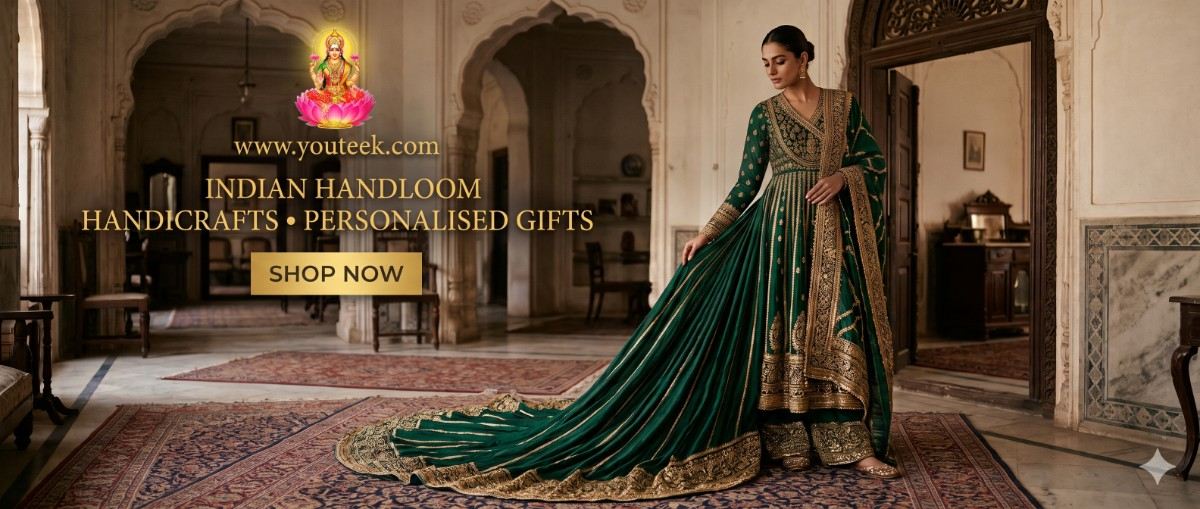
The Architecture of the Farshi Pajama: Courtly History, Silhouette Cuts, and Modern Evolution
Few traditional garments in the South Asian sartorial lexicon carry the regal grandeur of the Farshi Pajama (also historically termed Farshi Sutan or Farshi Salwar). Derived from the Urdu and Persian root word “Farsh” (meaning floor or ground), the word Farshi translates directly to “that which touches or sweeps the floor.”
Unlike standard trousers or pleated salwars of northern India and Central Asia, the Farshi pajama is an expansive, floor-length lower garment designed to pool elegantly around the feet and trail along the ground. During the 18th and 19th centuries, it stood as the definitive hallmark of aristocratic femininity, poise, and dynastic opulence across the courtly centers of Lucknow (Awadh), Rampur, and Hyderabad.
1. Historical Origins: Sartorial Amalgamation in the Courts of Awadh
The evolution of the Farshi pajama is deeply intertwined with the cultural renaissance of the Kingdom of Awadh. As Persian aesthetics melded with indigenous textile craft under the patronage of the Nawabs, court attire underwent a dramatic transformation.
Royal begums and court performers adapted Central Asian bifurcated robes into elaborate ensembles constructed for formal durbars and wedding celebrations:
- The Four-Piece Ensemble: Traditionally, a Farshi pajama was never worn in isolation. It formed the base of a strict four-part attire consisting of:
- The Farshi Bottom: Requiring anywhere between 9 to 15 meters of pure woven fabric.
- The Kurti: A short, structured, sleeveless or cap-sleeve bodice fitted closely to the torso.
- The Angrakha or Over-Tunic: A calf-length or knee-length tunic overlapping across the chest, tied with fabric ribbons.
- The Trailing Dupatta / Odhni: A heavy 3-meter veil embroidered with real gold or silver wire (Zardozi and Kamdani), draped across the chest and cascading over one shoulder.
- The Art of Movement: Walking in a Farshi pajama was considered an acquired art form. The sweeping extra fabric gathered at the hem was draped, tucked, or folded over the wearer’s left arm, allowing freedom of movement while walking or performing the delicate salaam gesture with the right hand.
2. Structural Geometry: How Farshi Differs from Gharara and Sharara
In contemporary fashion discourse, wide-legged bottoms are frequently conflated. However, their structural tailoring reveals distinct architectural identities:
| Garment Type | Silhouette & Construction | Flare Starting Point | Characteristic Feature |
|---|---|---|---|
| Farshi Pajama | Continuous, straight to flared panels (kalis) extending into an unbroken, sweeping floor-length train. | Continuous from hip/upper thigh to hemline | Expansive floor trail; requires manual gather when walking. |
| Gharara | Fitted closely from waist down to the knee, where it is gathered or pleated abruptly via a horizontal band (gote). | Abruptly at the knee joint | Prominent ruching/ruched flare below the knee joint; distinct decorative lace line. |
| Sharara | Flared uniformly downwards from the waist or mid-thigh, resembling a divided skirt or palazzo. | Flared continuously from waistband | No trailing train; hem typically ends just at floor/ankle height. |
3. Transition to 20th-Century Straight Cuts and Modern Pakistani Suits
By the early 20th century, rapid lifestyle shifts and the rise of lightweight fabrics (such as Georgette, Chiffon, and fine Lawn cotton) led noble families to streamline the voluminous Farshi cut. Everyday wear gravitated toward straight-cut trousers, cigarette pants, and the classic Punjabi shalwar.
However, the dramatic architecture of the Farshi cut never disappeared. Instead, it was absorbed into modern festive bridal couture across South Asia. Contemporary designers regularly revive Farshi silhouettes by pairing them with heavily embroidered long tunics, creating the structured, elongated look popular in festive fashion.
For modern festive celebrations, wedding guests and brides often gravitate toward these regal Awadhi cuts. To explore authentic interpretations of these elongated cuts, resham embroidery, and flared bottom wear, browse our curated collection of Pakistani Suits & Sets, which highlights heavy resham thread work, pure crepe fabrics, and tailored matching dupattas.
Documented extensively in South Asian textile records, the royal court attire of the era reflected an exquisite blend of Persian aesthetics and regional craftsmanship, as preserved in historical archives on the Kingdom of Awadh.
4. Fabric Weaves and Embellishment Techniques
The visual impact of a Farshi silhouette depends heavily on fabric choice:
- Pure Silk & Jamawar Brocade: Traditional court garments relied heavily on Banarasi katan silk and woven Jamawar weaves. The inherent stiffness of brocade maintains the structural flare without collapsing.
- Pure Crepe & Georgette: For contemporary celebrations, modern women prefer natural crepes and flowy georgettes. These fabrics offer fluid movement and a graceful drape without feeling excessively heavy.
- Zari and Resham Threadwork: The hems of Farshi garments traditionally feature broad borders (daaman) embellished with tilla, sitara, and resham thread embroidery to weigh down the bottom edge, ensuring the train sits flat on the carpet or marble floor.
When styling modern interpretations, pairing a flared bottom with a straight, floor-skimming shirt creates a slimming, vertical line. For those looking to incorporate royal heritage into their festive wardrobe, styling ready-to-wear embroidered Pakistani suits with traditional polki jewellery and mojaris offers a timeless aesthetic that honors centuries of royal craft.
5. Preserving Heritage Garments: Care & Maintenance
Because Farshi bottoms feature heavy, trailing hemlines that come into contact with floor surfaces, proper maintenance is essential:
- Hem Reinforcement: Traditional tailors line the bottom 3 to 4 inches with a protective inner lining (fall or magzi) to absorb friction and dust.
- Storage Protocol: Heavy silk and crepe Farshi sets should never be hung on wire hangers, as the weight of the bottom flares can stretch the seams. Fold them inside unbleached muslin cloth and store them flat.
- Cleaning: Always dry-clean garments with real metal wire (zari) or resham threadwork to prevent oxidation and color bleeding.
“The Farshi pajama remains an enduring symbol of South Asian courtly grace. From the marble corridors of Lucknow’s Bara Imambara to the modern wedding stage, its architectural cut preserves a rich lineage of royal craftsmanship, fluid movement, and textile mastery.”