

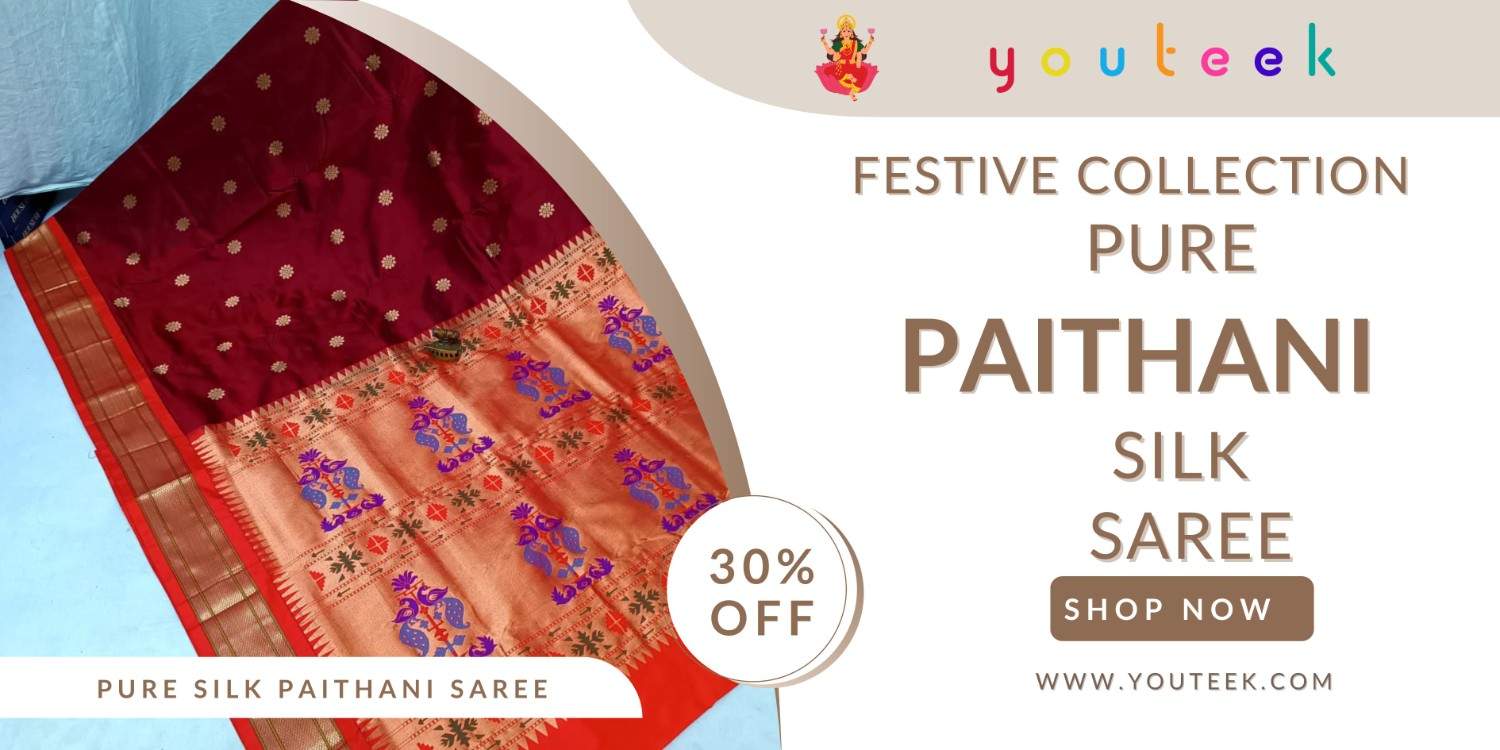
7 Tips to Identify a Pure Paithani Silk Saree: Complete Buying Guide
Revered as the “Queen of Silks” in Maharashtra, an authentic pure Paithani silk saree represents the pinnacle of Indian tapestry hand-weaving. Hailing from the historic town of Paithan near Aurangabad, Paithani sarees are world-renowned for their rich gold zari borders, kaleidoscope-like color shades, and hand-woven Mor (peacock) motifs on lavish tapestry pallus.
However, with cheap Jacquard powerloom imitations, printed motifs, and synthetic art-silk variants flooding online stores, identifying a genuine handwoven pure Paithani silk saree requires careful evaluation. In this comprehensive guide, our textile craft team outlines seven essential tips to test silk purity, inspect tapestry weaving, and buy an authentic heirloom drape.
What Makes a Pure Paithani Silk Saree Unique?
Unlike standard Jacquard weaves, a traditional pure Paithani silk saree is crafted using a hand-tapestry technique similar to Persian weaving. Artisans use fine 100% natural Mulberry silk yarns and pure gold-coated silver zari. The signature feature of a true Paithani lies in its weave: colored silk threads are interlocking-woven without mechanical Jacquard jacquards, making the motifs look practically identical on both the front and reverse sides.

7 Tips to Identify a Pure Paithani Silk Saree
Use these seven practical testing steps to verify authenticity before buying:
Tip 1: The Scientific Thread Burn Test
Gently pull a loose thread from the unstitched border or pallu tassel and expose it to a flame:
- Pure Natural Silk: Burns slowly, smells distinctly like burnt hair, stops burning immediately when removed from fire, and leaves soft, crushable black ash.
- Synthetic Fiber: Melts rapidly, smells like chemical plastic, and cools into a hard plastic bead.
Tip 2: Check the Identical Double-Sided Tapestry Pallu
Turn the saree over and examine the back of the peacock or lotus motifs on the pallu. In a real handloom pure Paithani silk saree, the reverse side is exceptionally neat, showing the exact same vibrant tapestry pattern as the front without any ugly loose thread floats or laser-clipped backing.
Tip 3: Look for Hand-Tied Shuttle Interlocking (Kadi-Yal)
Inspect the border joint. Authentic handloom Paithanis feature the traditional Kadi-yal interlocking border technique, where multiple colored shuttles are linked together manually by weavers. On powerloom knock-offs, borders are woven as continuous machine threads without manual interlocking seams.
Tip 4: Evaluate the Two-Tone Kaleidoscope Effect (Dhoop-Chhaav)
Pure Paithani sarees are famous for their iridescent “Dhoop-Chhaav” (Sun and Shade) color interplay created by weaving contrasting colored silk yarns in the warp and weft. As you drape or move the saree under light, the fabric smoothly shifts between two rich hues.
Tip 5: Inspect Metallic Zari Luster and Pure Silver Core
Traditional Paithanis utilize real metallic zari consisting of fine silver wire electroplated with pure gold. Gently inspect the underside of a main zari border: authentic real zari exhibits a soft, noble luster that will not scratch off or turn bright orange like synthetic metallic plastic film.
Tip 6: Feel the Organic Thermal Warmth
Gather a fold of the silk fabric and rub it vigorously between your palms for 5 to 10 seconds. Pure natural mulberry silk generates immediate, noticeable warmth against your hands due to its natural protein structure, unlike cool, slippery polyester or art-silk.
Tip 7: Verify Official Silk Mark Certification
Always demand the Silk Mark Organisation of India (SMOI) hallmark tag. This label guarantees that 100% natural silk was used in the warp and weft of the saree.
Pure Paithani Silk vs. Synthetic Powerloom Imitation
Use this feature comparison matrix to evaluate your saree before making a purchase:
| Feature | Pure Paithani Silk Saree | Synthetic Powerloom Replica |
|---|---|---|
| Weave Technique | Hand-tapestry weave; no loose threads on reverse | Machine Jacquard with scratchy thread floats on back |
| Motif Finish | Identical double-sided design on pallu | Single-sided print or clipped threads on reverse |
| Color Play | Natural two-tone Dhoop-Chhaav shimmer | Flat, single-shade synthetic tone |
| Burn Test | Burnt hair smell, crumbles into soft black ash | Melts fast, chemical smell, forms hard plastic bead |
| Durability | Heirloom longevity; retains luster for generations | Fades, frays, or loses shine after a few wears |
Styling Your Pure Paithani Saree for Maharashtrian Weddings
Styling a grand pure Paithani silk saree with a traditional green glass bangle set, a gold Pearl *Nath* (nose ring), and a crescent moon *Bindi* creates the quintessential royal Maharashtrian bridal look.
If you are comparing grand regional bridal handlooms, explore our buying guide on butter-soft pure Mysore silk sarees for minimalist luxury, or check out our guide on earthy pure Tussar silk sarees for textured formal wear.
Shop Authentic Pure Silks at Youteek
At Youteek, every handloom drape in our collection is curated directly alongside master weaving families and handloom cooperatives. Explore our verified pure saree collection to discover Silk Mark certified drapes, or browse our main handloom saree catalog for regional wedding drapes.
Frequently Asked Questions
How can I tell if a Paithani silk saree is real pure silk?
Perform a thread burn test on a loose warp or weft thread. Pure silk burns slowly with the smell of burnt hair and leaves fine soft black ash, whereas synthetic art-silk melts quickly into hard plastic beads.
What is the tapestry technique in a pure Paithani silk saree?
Paithani tapestry weaving involves interweaving multiple colored silk threads without float threads on the reverse side. This creates identical, mirror-like designs on both sides of the pallu.
What are the traditional motifs found on a pure Paithani saree?
Traditional Paithani motifs include the Mor (Peacock), Popat (Parrot), Lotus (Kamal), Hans (Swan), and Asavali (flower vase), woven intricately into the gold zari pallu and borders.